

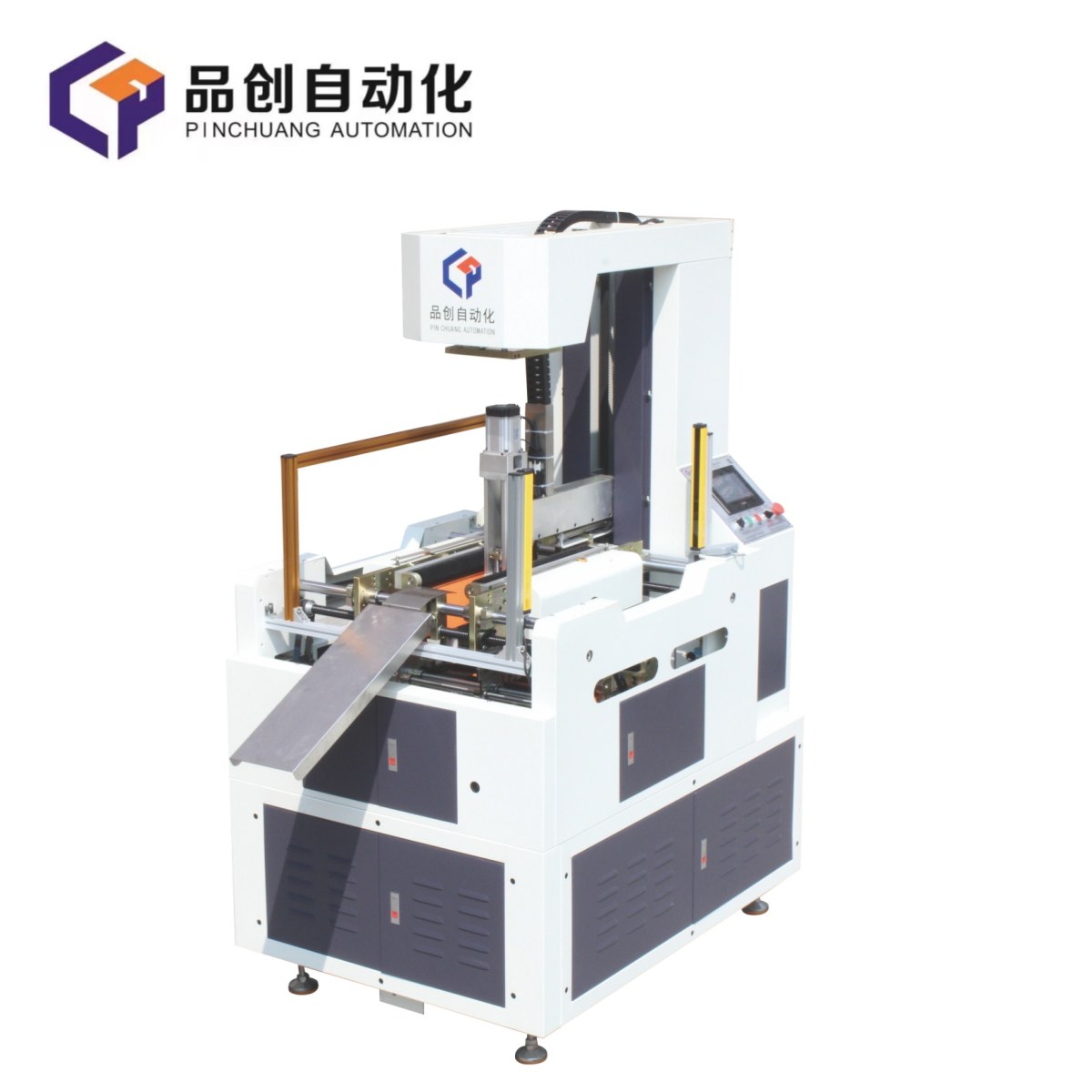
A rigid box forming machine is the station that pushes a flat wrapped panel into a mould and turns it into a three-dimensional box with a base and four walls. It is the last station in the line and the one where every earlier mistake becomes visible, because once the panel is pressed into shape, nothing downstream can correct a bad wrap or a shallow groove. Ask any experienced line operator which machine they would keep if they could only keep one, and most will name this one.
At Pinchuang, we have been manufacturing rigid box equipment in Dongguan since 2008, and the forming station is the machine most buyers ask to see running before they commit. This guide explains what the station actually does, the three quality markers it decides, how it depends on the stations feeding it, and how to judge forming quality from a single sample box rather than from a demonstration run.
What the Rigid Box Forming Machine Actually Does
Strip it back and the forming station does one physical thing: it takes a panel that has been glued and wrapped, locates it against a reference, and drives it into a mould or around a male form so the four sides turn up and the box takes its final geometry. That sounds simple until you look at what "locates it against a reference" has to survive.
The panel arrives with wet adhesive on it. It may be slightly distorted from gluing. The wrap may be textured, laminated or printed with a pattern that has to land in a specific place. The board underneath may vary by a few tenths of a millimetre between pallets. The forming station is the point where all of that variance either gets absorbed or gets printed onto the finished box.
On a modern rigid box forming machine the work is done by a combination of mechanical stops, servo-driven motion and, on premium configurations, vision correction before the panel is pressed. The operator's job is not to make the box but to confirm that the settings reproduce the approved sample.
On our current platform the forming stations cover a box range from 45 × 45 × 10 mm at the small end up to 500 × 400 × 120 mm, with a paper turn-in depth of 10–80 mm and corner ear folding of 10–90 mm. Those four numbers, more than any speed figure, tell you what box sizes a given station can actually form well.
Forming Accuracy: Three Markers That Decide the Box
"Accuracy" on a forming station is not one number. It is three separate qualities, and buyers who ask only about positioning precision usually miss two of them.
1. Squareness
A box that is out of square by a millimetre will not stack cleanly, will not sit flat in a display tray, and will show a visible gap when the lid is placed on top. Squareness is set by how the panel is located before forming, and it is the first thing to check on a finished box with a set square or by placing it on a flat surface and looking for a rock.
2. Corner tightness
Corner tightness is where the wrap folds over the corner flap. A loose corner shows a wrinkle or a small air pocket where the wrap has not been pulled tight. This is partly a forming problem and partly an upstream one: corner tape that is too short or glue that is too thin will leave a corner that no amount of forming pressure can rescue.
3. Surface wrinkles
Wrinkles on the panel face come from wrap tension and glue film rather than from the mould. Textured and heavier papers are far less forgiving, which is why visual positioning and controlled glue film matter more on premium work than on plain paper. A forming station can press a wrinkle flat, but it cannot remove it.
The three markers interact. A change that fixes wrinkles by increasing wrap tension can pull a corner loose. That is why the honest way to buy is to form your own box on the machine and inspect all three, rather than watching a demonstration on the supplier's sample.
The Stations That Feed It
A forming station can only form what it is given. Three upstream stations determine most of the quality that arrives at the mould.
- Gluing. An even adhesive film is the difference between a wrap that clings and a wrap that bubbles. An automatic paper gluing machine holds that film across the full sheet; a gluing station that runs dry at one edge will show up as lifting corners weeks later, in the customer's hands rather than in your own.
- V-grooving. A groove that is even across the panel folds cleanly into the corner. An automatic V grooving machine controls depth and angle; get either wrong and the board either cracks on the outside or shows a line through the wrap.
- Corner pasting. Tape on the corner flaps is what stops a rigid box from springing open months later. A corner pasting machine applies it consistently; tape depth should be set together with the box height.
This is the practical argument for treating the forming station as part of a system rather than as a standalone purchase. If you are adding forming to an existing line, the first question to ask is not which moulds to buy but whether the gluing and grooving upstream are repeatable enough to feed it.
Checking Forming Quality With One Sample Box
You do not need a full production run to judge a forming station. Take one box off the machine and work through this sequence. It takes two minutes and exposes almost everything.
- Place the box base on a flat surface and press one corner. If it rocks, the box is not square or the base has warped during forming.
- Turn it over and look along the base edge. A visible glue line or a shadow where the wrap meets the board means the turn-in is uneven.
- Run a finger along each of the four corners. Any wrinkle, sponginess or bubble is a corner that will open in transit.
- Hold the box up to a light and look across the panel face. Ripples and waves show wrap tension problems that will be invisible in a photograph but obvious to a customer.
- Place the lid on the base and check that the seams align on all four sides. Misalignment here is the fastest way for a retail buyer to reject a shipment.
Run the same checklist on the tenth box of the day and on a box from the end of a shift. A station that passes the first box and fails the tenth is a station with a heat or glue-drift problem, and that is a much more useful finding than a speed figure.
Two Forming Configurations to Compare
On our forming platform, the two stations that come up most often are the PC-450S and the PC-500S. Both cover the same maximum box size, but they are aimed at different points in the workflow — and that difference matters more than the headline speed.
| Parameter | PC-450S | PC-500S |
|---|---|---|
| Max. box size | L 500 × W 400 × H 120 mm | L 500 × W 400 × H 120 mm |
| Min. box size | L 45 × W 45 × H 10 mm | L 80 × W 60 × H 15 mm |
| Paper folding-in size | 10–80 mm | 10–80 mm |
| Production speed | 12–19 pcs/min | 15–22 pcs/min |
| Machine dimensions | L 1400 × W 1100 × H 2050 mm | L 2200 × W 1200 × H 2800 mm |
The small-box limit is the number to watch. PC-450S forms down to 45 × 45 × 10 mm, which suits jewellery and cosmetics work; PC-500S starts at 80 × 60 × 15 mm and adds a pick-up forming arrangement that suits a different handling flow. If your smallest box is 45 mm, that single figure decides which station you can use.
For scale reference, Pinchuang builds this equipment in a 10,000 m² facility in Dongguan with more than 100 employees, and the machines ship to over 30 countries. We have been making rigid box equipment since 2008, and we exhibit at All in Print China, Printing South China, China Print, Drupa, SINO FOLDING CARTON and WEPACK.


Whichever station you choose, the boxes it forms end up in the same narrow set of product categories — jewellery, watches, cosmetics, spirits, tea and gift sets. Looking at the applications we see most often is a quicker way to judge whether a forming range covers your order book than reading specification sheets line by line.
Common Questions About Forming Stations
Can a forming station run on its own?
It can, and plenty of plants start that way by adding forming to an existing bench operation. But a forming station buys you the least quality improvement on its own, because most of what it forms has already been decided by the gluing and grooving upstream. Adding it first usually makes sense only when those two steps are already under control.
What decides the smallest box a station can form?
The mould and the turn-in geometry rather than the machine frame. A station rated to 45 mm can form a very small box only if the wrap and board are handled accurately at that size; below a certain dimension the wrap becomes difficult to turn in without creasing. Always test your smallest size, not the nominal minimum.
Do I need vision positioning on a forming line?
It depends entirely on the wrap. Plain or lightly printed paper can be located mechanically. A printed pattern that must sit centred on the lid, or a textured wrap that shifts during gluing, benefits from a visual positioning machine reading marks and correcting position before the panel reaches the mould.
How do I know if my problem is forming or gluing?
Take a formed box and look at where the fault sits. Wrinkles across the panel face and bubbles under the wrap usually come from the glue film. Cracks along a fold line come from grooving. Loose or spongy corners can come from either. Cut one rejected box open along the corner if you need to be certain — it is faster than adjusting settings at random.
Send Pinchuang your smallest and largest box, your board thickness and a wrapped panel from your current process. We will run the sample and tell you which rigid box forming machine holds your size range, and whether the stations feeding it need attention first.
Send us a wrapped panel Compare every forming model